Sunday, October 2, 2016

Preamble of Debate


Interpretation or meaning of Preamble: According to Oxford English dictionary, meaning of Preamble as defined is ‘a preliminary or preparatory statement or an introduction.’

According to the interpreters of law, Preamble contains main object and purpose of any detail statute, enactment or a provision. Preamble thus is key to open the minds or the intention of the legislature.


Consequently, Constitution of India which is the Grundnorm and Preamble is its nutshell. Cardinal principle thus is Constitution through which the rest of the legislations should follow, otherwise any subsequent statute not in conformity with the Constitution of India shall be ultra vires or unconstitutional.


Secondly, preamble of the constitution is the very basis on which our ideals of the truly Independent India is founded and thus can be regarded as part of the “basic structure” of the constitution, subject to the following arguments as enumerated.


When preamble is itself is not an enacting provision, if India was to be declared a ‘Secular’ and ‘Socialist’ state then other options could have been provided to further due provisions in the constitution in the form of amendments to reinforce the original ideas, but what was the need to change the preamble?


In any case, when India became independent it converted from police state of the British Raj and wedded to the concept of a welfare state, so re-writing “socialist” word in preamble is not considered necessary from the legalities and welfare of the masses point of view.


Secondly, India was already a secular state and enactments are very vociferous with clarity in no uncertain terms, as expressed and implied particularly in Articles 25 to 30 about the secular nature of the State and hence incorporating “Secular” word separately in the preamble, which is not an enacting provision, was not a necessary condition for Governance then.

Secular norms of the society was well laid down in our constitution and there were no provisions in our constitution in the contrary or in conflict with secularism therefore, adding the word “Secular” in the preamble of the constitution which is not a enacting provision, I repeat, was not going to serve any additional meaningful purpose except for displeasing the God and the real intention of the legislators of the 42nd amendment needs to be well understood.

This apprehension becomes profound more because of the fact that the terms Socialist and Secular are not defined elsewhere in the Indian constitution.


Insertion of the word “Socialist” was proposed during the constituent assembly debates during pre-constitution period in forties but the founder fathers including the luminaries like Dr. BR Amvedkar opined that our constitution should not tie down the future generation about what the kind of society they wish to live in, there can be a better model than socialism in future, who knows! (#2)


Thus the amendment of inserting socialism was dropped at that time. Instead of Government of the day offering doles, freebies to meet the requirements of socialism, there can be an alternative in the form of a self-reliant society, where opportunities are equal and any form of disparity is strictly dealt with. Emphasis is better laid on the equal distribution of wealth in the society in the form of enactments and more importantly in the mobilization of implementation machinery for the purpose.


On the contrary the political parties are being asked to commit themselves to the socialistic cause to get permission from the Election Commission of India to participate in the process of election. Swatantra Party Maharastra was denied of registration by the Election commission in 1994 for not confirming written allegiance to Socialism.


This insertion of Socialist and Secular word in preamble was contested several times in Supreme Court. Some of the leading opinions were, “It is contrary to the Constitution and to its democratic foundations that political parties be called upon to swear allegiance only to a particular mindset or ideology,” said senior advocate Fali S Nariman, appearing for the petitioner, Kolkata-based NGO: Good Governance India Foundation.


Mr Nariman said, “Introducing the word ‘socialist’ in the Preamble breaches the basic structure and it is wholly inconsistent.” “The attempt to deliberately tunnel the collective view in one ideological direction is also a grave breach of the liberty provisions of the Constitution,” Mr Nariman said, seeking direction to strike down Sec 29A of the Representation of People Act. (#4)


In D.S Nakara v. Union of India, the court observed that, “the basic framework of socialism is to provide a decent standard of life to the working people and especially provide security from cradle to grave.” The principle aim of socialist State, the Supreme Court held, was to eliminate inequality in income and status and standard of life.


Under the ambit of the above case laws therefore ‘Adoption of mixed economy & globalisation’ which are buzz words today become ipso facto violative of constitutional provisions on socialism. However, we must note that socialism and welfare state mechanism are not necessarily the same thing and the same subject matter and cannot be treated as Pari materia.


Now one question still remain whether legislators had possessed right to alter or amend the basic structure in 1976 as done in 42nd amendment in accordance with Article 368 of the constitution. Consider the following provisions of Article 368, empowering parliament to amend Constitution.

Quote

Article 368 in The Constitution Of India 1949
368. Power of Parliament to amend the Constitution and procedure therefor
(1) Notwithstanding anything in this Constitution, Parliament may in exercise of its constituent power amend by way of addition, variation or repeal any provision of this Constitution in accordance with the procedure laid down in this article
(2) An amendment of this Constitution may be initiated only by the introduction of a Bill for the purpose in either House of Parliament, and when the Bill is passed in each House by a majority of the total membership of that House present and voting, it shall be presented to the President who shall give his assent to the Bill and thereupon the Constitution shall stand amended in accordance with the terms of the Bill: Provided that if such amendment seeks to make any change in
(a) Article 54, Article 55, Article 73, Article 162 or Article 241, or
(b) Chapter IV of Part V, Chapter V of Part VI, or Chapter I of Part XI, or
(c) any of the Lists in the Seventh Schedule, or
(d) the representation of States in Parliament, or
(e) the provisions of this article, the amendment shall also require to be ratified by the Legislature of not less than one half of the States by resolution to that effect passed by those Legislatures before the Bill making provision for such amendment is presented to the President for assent
(3) Nothing in Article 13 shall apply to any amendment made under this article
(4) No amendment of this Constitution (including the provisions of Part III) made or purporting to have been made under this article whether before or after the commencement of Section 55 of the Constitution (Forty second Amendment) Act, 1976 shall be called in question in any court on any ground
(5) For the removal of doubts, it is hereby declared that there shall be no limitation whatever on the constituent power of Parliament to amend by way of addition, variation or repeal the provisions of this Constitution under this article PART XXI TEMPORARY, TRANSITIONAL AND SPECIAL PROVISIONS

Unquote

Prior to 42nd amendment of 1976, in the year 1973, His Holiness Kesavananda Bharati Sripadagalvaru and Others versus State of Kerala (case citation 1973 4 SCC 225) is a landmark decision of the Supreme Court of India that outlined the ‘Basic Structure doctrine’ of the Constitution. Here in a well split ruling thirteen Judge bench decided the following in ratio of 7:6 after sitting reportedly for more than fifty times.


In this Judgment Supreme Court of India had emphasized that the Preamble to the Constitution emphasizes the principle of equality as basic to the Constitution of India. This is the basic features of the Constitution which no legislature in India can transgress. Even an Amendment of the Constitution offending a basic structure of the Constitution is ultra vires. (#1)


In this the majority propounded the novel doctrine of “basic features‟ as an implied limitation upon the amending power conferred by Article 368, not from the Preamble - but from an interpretation of the word “amendment‟ in Article 368 itself.


In formulating the basic features, the court referred to the objective specified in the Preamble, as other provisions, but it was nowhere stated that the Preamble as such constituted any substantive source of power or limitation apart from its other enacting provisions.


Kesavananda Bharati judgment created a history in Judicial review of the policy if the Government. For the first time, a constitutional bench of Judges assembled and sat in its original jurisdiction hearing the writ petition. Thirteen Judges placed on record eleven separate opinions. It was held in this case as:


a) Preamble to the Constitution of India is a part of Constitution.

b) Preamble is neither a source of power nor a source of limitation.

c) Preamble has a significant role to play in the interpretation of statues, also in the
Interpretation of the other provisions of the Indian Constitution.

d) The basic elements or structure in the preamble cannot be amended under Article 368.


The 42nd Amendment as enacted in 1976, is considered to be the immediate and most direct fall out of this above Judgment. Apart from it, the judgment has actually cleared the deck for complete legislative authority to amend any part of the Constitution except when the amendments are not in consonance with the basic structure of the Constitution.


Thus it may be construed that the legislators of that time had undertaken a colourable legislation by transgressing its authority in the first place to amend the basic structure of the constitution.


Circumstances of 42nd amendment
: This particular amendment as reported widely in press and other media as black day for the Indian democracy were passed by the parliament with majority of the opposition leaders under preventive detention under maintenance of internal security Act of 1971 popularly known as MISA Act.


Consequently leaders lost their right to vote in the respective legislation during passing of the constitutional amendment. As the passage of the bill was determined by two thirds majority by those present and voting norm.


On 25 June 1975, the President of India, Fakhruddin Ali Ahmed, accepted Prime Minister Indira Gandhi's recommendation to declare a state of “national emergency”. She argued that the political and civil disorder constituted a threat to national security. A state of emergency enabled the central government to issue executive decrees without requiring the consent of Parliament.

Elections were postponed and public gatherings, rallies and strikes were banned. Indira's government imposed "President's rule" in the states of Tamil Nadu and Gujarat, dismissing the governments controlled by opposition political parties.

The central government also imposed censorship on radio, television and newspapers. Across the country, police forces arrested thousands of opposition political activists, as well as leaders such as Jayaprakash Narayan, Jivatram Kripalani, Morarji Desai, Satyendra Narayan Sinha, Raj Narain, Vijay Raje Scindhia, Charan Singh, Atal Bihari Vajpayee, Lal Krishna Advani and others.

Opposition political organisations such as the Rashtriya Swayamsevak Sangh (RSS) and the Communist Party of India (Marxist) were banned and their leaders arrested.


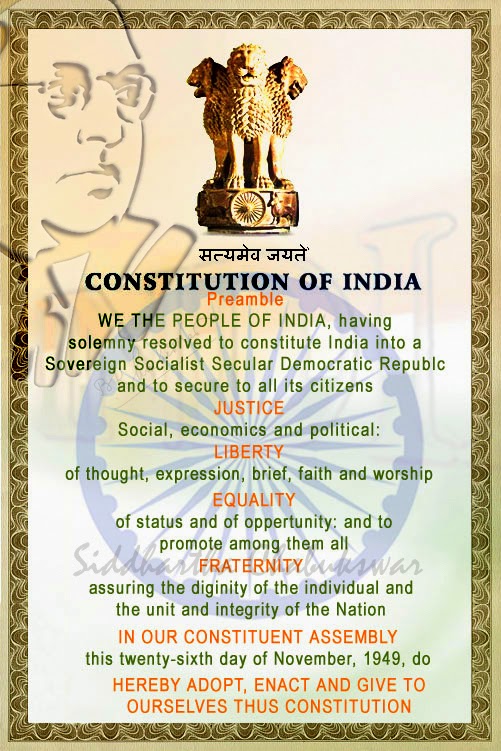
The Forty-second Amendment of the Constitution of India, brought about the most widespread changes to the Constitution in its history, and is sometimes called a "mini-Constitution". Here under the aforesaid circumstances the two words of Socialist and Secular was introduced in the line of SOVEREIGN SOCIALIST SECULAR DEMOCRATIC REPUBLIC. (#3)


Almost all parts of the Constitution, including the Preamble and amending clause, were changed by the 42nd Amendment, and some new articles and sections were inserted.


Position of the preamble prior to 42nd Amendment:

WE, THE PEOPLE OF INDIA, having solemnly

resolved to constitute India into a

SOVEREIGN DEMOCRATIC REPUBLIC and

to secure to all its citizens:

JUSTICE, social, economic and political;

LIBERTY of thought, expression, belief, faith and worship;

EQUALITY of status and of opportunity;

and to promote among them all

FRATERNITY assuring the dignity of the individual

and the unity and integrity of the Nation;

IN OUR CONSTITUENT ASSEMBLY this twenty sixth day of November, 1949, do HEREBY

ADOPT, ENACT AND GIVE TO OURSELVES THIS CONSTITUTION.


Conclusion: The Constitution of India is the supreme law of the land, which is fundamental to the governance of India. The Constitution of India was enacted on 26th November, 1949 and was adopted on 26th January, 1950. The makers of the Indian Constitution took lot of pain and obtained inspiration from Constitutions all over the world and incorporated their attributes into the Indian Constitution.


However, a Constitution should be a dynamic document. It should be able to adapt itself to the changing needs of the society. Sometimes under the impact of new powerful social and economic forces, the pattern of government will require major changes. Keeping this factor in mind the founders of the Indian Constitution incorporated Article 368 in the Constitution which dealt with the procedure of amendment. During the last 70 years of the Constitution, more than 120 amendments have taken place, GST being the 122nd.


Amendments were to serve the needs of the evolving society, welfare of the masses and general elevation of the socio economic order in the country.


However, 70 years down the line look at what we all have done to our country! There is huge disparity in the society in the form of rural urban divide, a slum cluster and a sky scrapper both exist side by side in our leading cities of Mumbai, Delhi, Bangalore, Kolkata, etc.

In the name of secularism our politicians try to divide our country at the first available opportunity. India still is largely divided on religious lines.


Subsequent Governments which assumed power during the post emergency period also did not endeavour to modify the past errors but it can only be attributed to nothing but political compulsions or lack of majority or public support to bring about reversal.


Most important is to see net results and what’s our achievement after independence in terms of attaining social goal, secular goal???


Insertion of the two words of Secular and Socialist for the last forty years in the preamble has hardly served any visible purpose, and it has been only a delusionary attempt meant for the huge illiterate mass of the country.

So it can thus be construed that the law making in this country is purely motivated by political compulsions and do not necessarily grab the imagination of the ordinary masses of the country.


Spiritual mystic Sadhguru Jaggi Vasudev once Tweeted, “Compulsion may be towards something edible, a particular activity... Anything compulsive means you are enslaved.” So our political compulsions are making ourselves the slaves of vote bank.


So it finally transpires that, if one need to fight for its own basic rights then it may be an good idea to form a formidable group and thereby gain political power to garner support and attain political objectives. We need to break this tradition that forming groups is the only solution to the problems facing our society, but NO, instead we may try to globalize our society, encourage flow of ideas and culture all across the nation and make it a coherent one where vote bank politics can be crushed and pursuer of the vote bank policy shall be a utter failure.


#JaiHind


#1. http://www.legalservicesindia.com/article/article/role-of-preamble-interpretation-with-indian-constitution-1390-1.html

#2. http://swarajyamag.com/commentary/the-2-s-words-ambedkar-did-not-want-in-the-constitution

#3. http://www.lawctopus.com/academike/preamble-constitution-india/
#4. http://www.sabhlokcity.com/2015/04/record-of-actions-pils-against-socialism-in-indias-preamble-rop-act/


Sunday, September 4, 2016

Environment, Dharma & Constitution of India


Not until I got an opportunity to study Jurisprudence in Law school, ‘Dharma’ as the term very often portrayed in our daily lives, used to be ordinarily perceived as the Sanskrit word for religion in my consciousness since childhood days!

But while studying the principle of ‘Dharma’ in detail, could discern slowly but surely that it is not just a religion but a bit more than that actually. According to Vedic wisdom traditions Dharma as elaborated is not just a religion, like Yoga is not just a physical training regime but are disciplines of science for controlling and conducting our lives and means to celebrate it.


1.0 Dharma – the principle of harmonious co-existence and not religion


Principles by which we need to align ourselves to elements and forces of the universe, to yield a harmonious relationship with it, are called ‘Dharma’. (#3) For example things which we have to necessarily observe in our daily life and in social relations and while interacting with our surroundings, etc., is also constituted by what is called as ‘Dharma’. Actually this term ‘Dharma’ is much wider and not religion per se but encompasses righteousness, rule of law, duty, obligations, rituals, religious practices and ‘Sadachar’ (harmonious behavior).

We may become masters in our pursuits of chosen discipline and obtain the highest qualification in the field, but back at work and home if we are unable to deal with situations and lead a much stressed life, then the chances of success being pronounced in our lives is not only dim but remotest of the remote possibility, Dharma allows us that leverage.

The texts of pristine glory and grandeur, Bhagavad Gita (7.19, 13.13) and the Bhagavad Purana (2.2.41, 2.2.45), contain many references to the omnipresence of the Supreme divinity, including its presence throughout and within nature. Vedas accept the presence of God in nature. For example, many think of India's mighty rivers - such as the Ganges and Yamuna - as goddesses. In the Mahabharata, it is noted that the universe and every object in it has been created as an abode of the Supreme God meant for the benefit of all, implying that individual species should enjoy their role within a larger system, in relationship with other species.

Protecting the environment is part of Dharma, which is one of the most important Vedic concepts, has been translated into English as duty, virtue and cosmic order but not entirely a religion. According to Vedas, protecting the environment is an important expression of Dharma.

There are those communities who carry out many conservation-oriented practices not as "environmental" acts but rather as expressions of dharma. When Bishnois are protecting animals and trees, when Swadhyayis are building Vrikshamandiras (tree temples) and Nirmal Nirs (water harvesting sites) and when Bhils are practicing their rituals in sacred groves, they are simply expressing their reverence for creation according to Vedic teachings, not for "restoring the environment." These traditional Indian groups do not see religion, ecology and ethics as separate arenas of life. Instead, they understand it to be part of their Dharma to treat creation with respect. (#6)

Dharma prescribes modest living and minimum consumption and maximum conservation of the natural resources for sustenance of human life, no wonder today our greatest role model for deceptively simple living is none other than Mahatma Gandhi, the father of the nation.

Ancient Manusmriti, the first codified law timed around 500 BC is the first ‘Rule of Law’ in the history of the Mankind! – said, journalist Tavleen Singh via Twitter. Vedic wisdom traditions had acknowledged during the period around 500 BC when the Latin & English laws were not developed, the ‘Rule of law’, having components of supremacy of Law, predominance of legal spirit and equality before the law, were advocated in Manusmriti but this very legal principle’s modern proponent is Prof. AV Dicey who came out with details only towards the end of nineteenth century. Prof. Austin’s the father of modern jurisprudence had said “Law is the command of the sovereign” it holds good in Manusmriti (Chapter VIII Verse 1 to 8). Manusmriti details Dharma and shows its legitimate path.

Men are a product of the universe and are a teachable animal, blessed with intelligence and can modify the course of the natural laws to a certain extent. Here comes the initiation of the problem and reasons for all the issues being raised today for sustainable development, global warming, carbon emission and degradation of the universal living standards.

According to Vedas there are two major aspects in the universe such as ‘Prakriti’ i.e. nature and ‘Purusha’ i.e. Men. Nature has certain definitive courses which happen on its own but Men can modify the course to a certain extent. This capacity of human intervention in the natural discourse is the principal reason for chaos such as Global warming and the huge concern about the sustainability of the World order.

So finally, when the principle was well understood, that means that there is a constant need for us to adjust our selves to yield a harmonious relationship with all that is provided in abundance by the nature and its laws of the universe and the rules we need to follow to suit the circumstances and the environment is called ‘Dharma’, that made me feel pity not only for myself but also for the protagonists of this much misunderstood terminology.

Therefore, unless the principles of ‘Dharma’ are followed with great sense of responsibility, the environment shall not remain unconditioned and unaltered and the Earth will not be a better place to live in the days to come.


2.0 Environment: - what is the extent of it


2.10. Environment: Ordinarily we may perceive Environment as immediate surroundings to our existence; however, the definition encompasses the cosmos in entirety as there are continuous exchanges taking place between our mother earth and everything else that exists in the cosmos. For example one atom that we have in our body may have been part of the stars that we see at night and exchange of atomic particles takes place so fast that we can exchange the atom of a peasant in China in 3 weeks and a taxi driver from Bihar in 2 weeks while living in Mumbai! (#4)


Specifically to our immediate existence, the natural environment encompasses all living and non-living beings, all moving and non-moving things, occurring naturally on Earth and not external to it, which are meant to be continuously interacting with each other as a continual process of exchange. Now most importantly, climate, weather and natural resources that are derived from the mother earth, affect human survival and economic activity either in progressive or in regressive manner.

The concept of the natural environment can be distinguished by the following two major components:

a. Complete ecological units that function as independent natural systems without massive civilized human intervention, including all vegetation of flaura and fauna, microorganisms, soil, rocks etc., having natural phenomena that occur within their boundaries and their nature. That is one having perceived finite shape.

b. Universal natural resources and physical phenomena that lack clear-cut boundaries, such as air, water, and climate, as well as energy, radiation, electric charge, and magnetism, force of gravity not necessarily originating from civilized human activity. That is the other component having no finite shape.


In far contrast to the natural environment there is the Men made environment. In such areas where men have fundamentally transformed landscapes such as urban settings and agricultural land configuration, natural course of river, etc., the natural environment is greatly modified, while its intrinsic value gets greatly diminished at times. Even, events which seem less harmful, such as hydroelectric project or solar power systems construction in the deserts etc., all these lead to disturbance of the equilibrium of the natural environment.

Waste product generation due to daily human living activity is yet another menace disturbing the environment. The amount of waste that is generated on daily basis if not handled properly shall lead to chaos and degradation of quality of lives for the each individual.(#7) India is far behind this aspect in dealing with municipal and other industrial wastes compared to the developed nations, much remains to be done in this domain.


2.20 Global Warming: Global Warming is the increase of Earth's average surface temperature due to effect of greenhouse gases, such as carbon dioxide emissions from burning fossil fuels or from deforestation, which trap heat that would otherwise escape from Earth. This is a type of greenhouse effect. (#1)

Global warming and climate change are terms for the observed century-scale rise in the average temperature of the Earth's climate system and its related effects. Multiple thoughts of scientific evidence show that the climate system is warming. Although the increase of near-surface atmospheric temperature is the measure of global warming often reported in the popular press, most of the additional energy stored in the climate system since 1970 has gone into the oceans. The rest has melted ice and warmed the continents and atmosphere. Many of the observed changes since the 1950s are unprecedented over tens to thousands of years.

Currently, about half of the carbon dioxide released from the burning of fossil fuels remains in the atmosphere. The rest is absorbed by vegetation and the oceans. Climate model projections summarized in the report indicated that during the 21st century the global surface temperature is likely to rise a further 0.3 to 1.7 °C (0.5 to 3.1 °F) for their lowest emissions scenario and 2.6 to 4.8 °C (4.7 to 8.6 °F) for the highest emissions scenario.

Public reactions to global warming and concern about its effects are also increasing. United States of America and China the two large economies have been blamed squarely for much of the global warming and climate change.


2.30. Sustainable Development: This means an integration of development and environmental forces is imperative and development should take place in harmony with environmental considerations. Justifiable development must possess both economic and ecological sustainability. Otherwise it cannot be termed as development but may be a near destruction for impending disaster. It is therefore needed that a development process should be where exploitation of resources, direction of investment, orientation of technology implementation and institutional changes are all in harmony with the environment to maintain its natural order. Sustainable development also implies local control over the resource use, and is the only path for conserving and promoting socio-economic well-being in a rationalistic form.

Sustainable development has therefore formidable interface with environment and human evolution and it can be taken care through the Grundnorm of constitutional provisions and reforms thereof.


2.40. Indian Scenario: There are three fold component of development one in the real estate sector and the others in infrastructure of facilities and industries.

Indian Governmental impetus thus on solar energy, forest protection, river protection and river cleaning are definitely steps towards positive direction in this regard as can be assumed. The situation here in our country is as deplorable as ever and in metro cities like Mumbai, Delhi, Kolkata, Bangalore, Bengaluru, Chennai one cannot take a smooth walk down any street unless encountered by stink and dirt of waste material piled up all over the place. The waste generation in the city of Mumbai has since doubled in last 30 years. (#7) This is because the waste generation has much outweighed the capacity to handle by the respective Municipalities due to the near population explosion, which no one is ready to admit. Today smoking has become safer than to inhale Delhi air for example!


Therefore, Governmental initiatives on Swatchha Bharat Aviyan is laudable and visionary in the wisdom that it intends to control the generation and handling of the human and industrial waste with a sense of rationale.

Government programs of use of Green Buildings, LEED & GRIHA certified buildings are imperative to conserve energy and ensure sustainability.

Green building or sustainable building refers to both a structure and the using of processes that are environmentally responsible and resource-efficient throughout a building's life-cycle: from conception to design, construction, operation, maintenance, renovation, and demolition. A green building is supposed to be the most energy efficient habitats and consumes least energy for its sustenance.

Leadership in Energy and Environmental Design (LEED) is basically a third-party certification program. It is a nationally accepted organization for design, operation and construction of high performance green buildings.

Green Rating for Integrated Habitat Assessment (GRIHA) was conceived by The Energy and Resources Institute (TERI) and developed with Ministry of New and Renewable Energy, is a national rating system for green buildings in India.

GRIHA is an acronym for Green Rating for Integrated Habitat Assessment. GRIHA is a Sanskrit word meaning – ‘Abode’. Human Habitats interact with the environment in various ways. Throughout their life cycles, from construction to operation and then demolition, they consume resources in the form of energy, water, materials, etc. and emit wastes either directly in the form of municipal wastes or indirectly as emissions from electricity generation etc. GRIHA attempts to minimize a building’s resource consumption, waste generation, and overall ecological impact to within certain nationally acceptable limits / benchmarks.

Today Air-Conditioning is a huge source of environmental imbalance. Corporate offices in Japan nowadays do not allow people with suits or jackets as then the requirement to keep the internal temperature becomes lower and higher electricity is consumed and higher heat is released to the atmosphere.


3.0 Environment & The Constitution of India


To protect and improve the environment is a constitutional mandate recognized by our founding fathers. It is the commitment for a socialistic country as ours wedded to the ideas of a welfare State, to provide clean and natural environment to our citizens. The Indian constitution contains specific provisions for environmental protection under the chapters of Fundamental Duties and Directive Principles of State Policy. (#2)

The absence of any specific provision in the Constitution recognising the fundamental right to (clean and wholesome) environment has been set off by judicial activism in the recent times. The Constitution enjoins upon the Court a duty to protect the environment.

When we talk of the environmental protection and its relation to the legal systems in India Advocate MC Mehta’s contribution to the environmental laws through judicial activism is most exemplary.

Constitution of India 1949 and subsequent amendments thereof has the following provisions with respect to environment that can be interpreted to be profoundly connected:-

3.10. Article 14: Equality before law: “The State shall not deny to any person equality before the law or the equal protection of the laws within the territory of India Prohibition of discrimination on grounds of religion, race, caste, sex or place of birth.”

The right to equality may also be infringed by government decisions that have an impact on the environment. An arbitrary action must necessary involve a negation of equality, thus urban environmental groups often resort to Art.14 to quash arbitrary municipal permission for construction that are contrary to development regulations, in the interest of the preservation of the environment.

3.11. Article 19(1)(g): “to practice any profession, or to carry on any occupation, trade or business.”

However, it goes naturally with a reasonable restriction that in the interest of public welfare one cannot practice a profession that would lead to damage of the habitation surroundings and environment. Like noise creating pollution around the educational institutions, hospitals, residential areas or silence zone are always challenged through prevailing legal system and mechanism.

3.12. Article 21 Protection of life and personal liberty: “No person shall be deprived of his life or personal liberty except according to procedure established by law.”

Life under the safe and unaltered healthy environment has also been recognized under above provisions of Right to Wholesome Environment.

Judicial Interpretation to Right to Life and Environment: The right to healthy environment has been incorporated, directly or indirectly, into the judgments of the court. Link between environmental quality and the right to life was first addressed by a constitutional bench of the Supreme Court in the Charan Lal Sahu Case. In 1991, the Supreme Court interpreted the right to life guaranteed by Article 21 of the Constitution to include the right to a wholesome environment.

While interpreting Article 21 in Ganga Pollution Case, Justice Singh justified the closure of polluting tanneries observed: "we are conscious that closure of tanneries may bring unemployment, loss of revenue, but life, health and ecology have greater importance to the people."

In Subash Kumar case the Court observed that ‘right to life guaranteed by article 21 includes the right of enjoyment of pollution-free water and air for full enjoyment of life.’ Through this case, the court recognized the right to a wholesome environment as part of the fundamental right to life of the citizens. This case also indicated that the municipalities and a large number of other concerned governmental agencies could no longer rest content with unimplemented measures for the abatement and prevention of pollution. They may be compelled to take positive measures to improve the environment.

This was reaffirmed in M.C. Mehta v. Union of India. Where, the case concerned the deterioration of the world environment and the duty of the state government, under Article 21, to ensure a better quality of environment. The Supreme Court has held that life, public health and ecology have priority over unemployment and loss of revenue. The Supreme Court ordered the Central government to show the steps they have taken to achieve this goal through national policy and to restore the quality of environment.

In Taj Mahal's case (M C Mehta V. Union of India, AIR 1997, SC 734), the Supreme Court issued directions that coal and coke based industries in Taj Trapezium (TTZ) which were damaging Taj should either change over to natural gas or to be relocated outside TTZ.

In the landmark case of M. C. Mehta vs. Union of India 1987 SCR (I) 819 (the Oleum Gas Leak case), the Supreme Court established a new concept of managerial liability – ‘absolute and non-delegable’ – for disasters arising from the storage of or use of hazardous materials from their factories. The enterprise must ensure that no harm results to anyone irrespective of the fact that it was negligent or not. It may be noted that the polluter pays principle evolved out of the rule of ‘absolute liability’ as laid down by the apex court in above Sriram Gas Leak Case.

In Vellore Citizens Welfare Forum vs. Union of India, AIR 1996 SC 2715, the Supreme Court held that industries are vital for the country’s development, but having regard to pollution caused by them, principle of ‘Sustainable Development’ has to be adopted as the balancing concept.

The Supreme Court has laid down that the "Precautionary principle" and the "Polluter Pays Principle" are essential features of "sustainable development". These concepts are currently part of Environment Law of the country.

The "Precautionary Principle" establishes that a lack of information does not justify the absence of management measures. On the contrary, management measures should be established in order to maintain the conservation of the resources. The assumptions and methods used for the determination of the scientific basis of the management should be presented.

Thus, pollution created as a consequence of development must be commensurate with the carrying capacity of our ecosystem.

3.14. Article 47: “Duty of the State to raise the level of nutrition and the standard of living and to improve public health The State shall regard the raising of the level of nutrition and the standard of living of its people and the improvement of public health as among its primary duties and, in particular, the State shall endeavour to bring about prohibition of the consumption except for medicinal purposes of intoxicating drinks and of drugs which are injurious to health”

3.15. Article 48. Organisation of agriculture and animal husbandry “The State shall endeavour to organise agriculture and animal husbandry on modern and scientific lines and shall, in particular, take steps for preserving and improving the breeds, and prohibiting the slaughter, of cows and calves and other milch and draught cattle.”

Cows who produce milk which being the one of the few wholesome food need to be protected and conserved for maintaining ecological balance and not to be simply produced as meat for consumption without due consideration just to make India the largest meat producer in the World at the cost of the environment. This provision exists since 1949 without much attention. Population of cows needs to be commensurate with the human population of India to ensure abundant availability of milk and milk products, mainly for consumption of children.

3.16. Article 48A: Protection and improvement of environment and safeguarding of forests and wild life, “The State shall endeavour to protect and improve the environment and to safeguard the forests and wild life of the country.”

A global adaption consciousness for the protection of the environment in the seventies prompted the Indian Government to enact this in the 42nd Amendment (1976) to the Constitution.

3.17. Article 51A (g): “to protect and improve the natural environment including forests, lakes, rivers and wild life, and to have compassion for living creatures.” This is a responsibility imposed upon on every citizen in the form of Fundamental Duty.

The above 42nd amendments also introduced certain changes in the Seventh Schedule of the Constitution. ‘Forest’ and ‘Wildlife’ were transferred from the State list to the Concurrent List. This shows the concern of Indian parliamentarians to give priority to environment protection by bringing it out as the national agenda. Although unenforceable by a court, the Directive Principles are increasingly being cited by judges was a complementary to the fundamental rights. In several environmental cases, the courts have been guided by the language of Art. 48A. and interpret it as imposing “an obligation” on the government, including courts, to protect the environment.

In L.K Kollwal V State of Rajasthan, a simple writ petition by citizens of Jaipur compelled the municipal authorities to provide adequate sanitation. The court observes that when every citizen owes a constitutional duty to protect the environment (Art.51A), the citizen must be also entitled to enlist the court’s aid in enforcing that duty against recalcitrant State agencies. The Court gave the administration six month to clean up the entire city, and dismissed the plea of lack of funds and staff.

The Public Trust Doctrine, evolved in M.C. Mehta v. Kamal Nath, states that certain common properties such as rivers, forests, seashores and the air were held by Government in Trusteeship for the free and unimpeded use of the general public. Granting lease to a motel located at the bank of the River Beas would interfere with the natural flow of the water and that the State Government had breached the public trust doctrine.

A matter regarding the vehicular pollution in Delhi city, in the context of Art 47 and 48 of the Constitution came up for consideration in M.C. Mehta vs. Union of India (Vehicular Pollution Case). It was held to be the duty of the Government to see that the air did not become contaminated due to vehicular pollution. The Apex court again confirming the right to healthy environment as a basic human right stated that the right to clean air also stemmed from Art 21 which referred to right to life. This case has served to be a major landmark judgment because of which lead-free petrol supply was introduced in Delhi. There was a complete phasing out old commercial vehicles more than 15 years old as directed by the courts.

The Ganga Water Pollution case: M C Mehta V. Union of India, AIR 1988, SC 1037. The owners of some tanneries near Kanpur were discharging their effluents from their factories in Ganga without setting up primary treatment plants. The Supreme Court held that the financial capacity of the tanneries should be considered as irrelevant while requiring them to establish primary treatment plants. The Court directed to stop the running of these tanneries and also not to let out trade effluents from the tanneries either directly or indirectly into the river Ganga without subjecting the trade effluents to a permanent process by setting up primary treatment. This is in consonance with Article 51A.

This has led to setting up of large numbers of water and effluent treatment plants all across the country and is now a major impetus area of sustainable development.


3.18. Article 246: This provision state:-

(1) Notwithstanding anything in clauses ( 2 ) and ( 3 ), Parliament has exclusive power to make laws with respect to any of the matters enumerated in List I in the Seventh Schedule (in this Constitution referred to as the Union List)
(2) Notwithstanding anything in clause ( 3 ), Parliament, and, subject to clause ( 1 ), the Legislature of any State also, have power to make laws with respect to any of the matters enumerated in List III in the Seventh Schedule (in this Constitution referred to as the Concurrent List)
(4) Parliament has power to make laws with respect to any matter for any part of the territory of India not included (in a State) notwithstanding that such matter is a matter enumerated in the State List.

Art.246 of the Constitution divides the subject areas of legislation between the Union and the States.

The Union List (List I) includes defense, foreign affairs, atomic energy, intestate transportation, shipping, air trafficking, oilfields, mines and inter-state rivers.

The State List (List II) includes public health and sanitation, agriculture, water supplies, irrigation and drainage, fisheries.

The Concurrent list (List III) (under which both State and the Union can legislate) includes forests, protection of wildlife, mines and minerals and development not covered in the Union List, population control and factories. From an environmental standpoint, the allocation of legislative authority is an important one – some environmental problem such as sanitation and waste disposal, are best tackled at the local level; others, like water pollution and wildlife protection, are better regulated uniform national laws.


3.19. Article 253: Legislation for giving effect to international agreements, “Notwithstanding anything in the foregoing provisions of this Chapter, Parliament has power to make any law for the whole or any part of the territory of India for implementing any treaty, agreement or convention with any other country or countries or any decision made at any international conference, association or other body.”

The Tiwari Committee in 1980 recommended that a new entry on “environmental Protection” be introduced in the concurrent list to enable the centre to legislate on environmental subjects, as there was no direst entry in the 7th seventh enables Parliament to enact comprehensive environment laws. The recommendation, however, dealt to consider parliament’s power under Art.253

To implement the decision taken in the Stockholm Conference, the Parliament enacted the Air Act under Article 253.


3.20 Environmental laws: Based on the constitutional Grundnorm the subsequent environmental laws were framed by our law makers and are currently in operation.

3.21. Environmental protection Act 1986 authorises the central government to protect and improve environmental quality, control and reduce pollution from all sources, and prohibit or restrict the setting and /or operation of any industrial facility on environmental grounds.

3.22. Water prevention & control of pollution Act 1974, authorises central and state authorities to provide for the prevention and control of water pollution and the maintaining or restoring of wholesomeness of water, for the establishments operating within its jurisdiction.

3.23. The Air (Prevention And Control Of Pollution Act, 1981) it controls mainly air pollution and its abatement. Also establishes air quality standards. The Central and State Boards set up independently to notify emission standards.

3.24. The objective of Hazardous Waste (Management and Handling) Rules 2008 is to control the generation, collection, treatment, import, storage, and handling of hazardous waste.

3.25. The Indian Forest Act and Amendment, 1984, is one of the many surviving colonial statutes since 1927. It was enacted to ‘consolidate the law related to forest, the transit of forest produce, and the duty leviable on timber and other forest produce’.


3.26. Biomedical waste management & handling rules 1998, It imposes duty to every institution generating bio-medical waste which includes a hospital or allied services, veterinary institution etc., to take all steps to ensure that such waste is handled without any adverse effect to human health and the environment.


3.30. The Bhopal Gas Leak Case

While writing on the topic of environment, if Bhopal Gas Leak case is not mentioned anywhere then the whole effort remains incomplete.

The Bhopal disaster raised complex legal questions about the liability of foreign based parent companies for the acts of their subsidiaries in India, the responsibilities of multinational corporations engaged in hazardous activities, the transfer of hazardous technologies and the applicable principles of liability. Bhopal incident was inspirational factor for the judicial innovation in the area of evolving principles of corporate liability for use of hazardous technology.

On December 3, 1984, highly toxic methyl isocyanides (MIC), which had been manufactured and stored in Union Carbide’s chemical plant in Bhopal, escaped into the atmosphere and killed over 3,500 people and seriously injured about 200,000 people.

High Court Judgment: Justice Seth used English Rules of procedure to create an entitlement to interim compensation (i.e. it is permissible for courts to grant relief of interim payment under the substantive law of torts). Under the English rules, interim relief granted in personal injury cases if a prima facie case is made out. Justice said that “more than prima facie case have been made out” against the Carbide.

He observed that the principle of absolute liability without exceptions laid down in M.C. Mehta case applied more vigorously to the Bhopal suit. He holds that Carbide is financially a viable corporation with $ 6.5 billion unencumbered asset and $200 million encumbered assets plus an insurance which could cover up to $250 million worth of damages. Given carbide’s resources, it is eminently just that it meet a part of its liability by interim compensation amounting to Rs. 2500 Million.

In Union Carbide Corporation (UCC) v Union of India (AIR 1990 SC 273), the Supreme Court secured a compromise between the UCC and Government of India. Under the settlement, UCC agreed to pay US $470 million in full and final settlement of all past, present and future claims arising from the Bhopal disaster. In addition to facilitate the settlement, the Supreme Court exercised its extraordinary jurisdiction and terminated all the civil, criminal and contempt of court proceedings that had arisen out of the Bhopal disaster. It was declared by the court that if the settlement fund is exhausted, the Union of India should make good the deficiency.

Review petition under Art.137 and writ petitions under Art.32 of the Constitution of India were filed questioning the constitutional and under the Bhopal Act and the resultant categorization of the victims was also upheld. It was laid down that there is no need to tie down the tort feasor to future liability.

While determining the Criminal Liability of Carbide Officials, the supreme court reinstated criminal charges for homicide not amounting to murder’ (Sec. 304,Part II, IPC) against top executives at UCC (viz. nine employees and three foreign accused, including Warren Anderson, the CEO) while uploading the rest of the settlement. The CBI in December 1993 finally prepared the documents necessary to extradite Warren Anderson. However, Government of the day failed to retain and try him under Indian Laws and he escaped to USA reportedly under a Quid pro quo agreement, as reported in the press. (#7)


4.0 Conclusion

1972 Stockholm Declaration affirms that "Man has the fundamental right to freedom, equality and adequate conditions of life, in an environment of quality that permits a life of dignity and well-being, and he bears a solemn responsibility to protect and improve the environment for present and future generations." This shows that it has been internationally recognized that man's fundamental rights embraces the need to live in an uncontaminated environment but it also puts forth man's obligation to protect the environment for prosperity.

Industrialisation coupled with Urbanisation and least emphasis on rural economy have skewed the population in the cities compared to the rural populace to a very extreme dimension and the time is ripe to action these trend to reverse them as soon as possible to save the Indian Civilisation.

But population is bound to increase till GOD loses its faith on humanity and in Tagore’s words: “Every child comes with the message that God is not yet discouraged of man.” – Recently Junnaid Matto of National conference of Jammu & Kashmir was blessed with a daughter and he so twitted and in response had to quote Tagore. (#5)

As of today there exist no constitutional provisions on population control measures, although it is well within the comprehension of legislators that it is ‘the issue’ and the same is assuming serious proportions.

Stress is perpetually generating and Men are being drawn away from nature to concrete jungles. Communion with nature on a daily basis is the requirement to enhance energy, creativity and accessing the abundant resource of nature & balancing of self with nature in harmony thus following the first principle of Dharma.


The existence of life on earth depends on the harmonious relationship between ecosystem and environment. Especially homo-sapiens have very close interaction with nature. Human beings are at the centre of concerns for Sustainable Development and World Order that they are entitled to a healthy and productive life in harmony with nature. The urgent need of the hour thus is that it is essentially to be embedded in the consciousness of every individual that Environment and Life are interrelated and there is perpetual exchange amongst us and the rest of the universe. Thus protection of environment is our paramount duty & Dharma.

However, in the quest of misconceived reality of money making, which is becoming sole pursuit in our lives, we all need course correction. Had that been so, then Mohandas Karamchand Gandhi who had left a total assets worth 31 cents US$ (1 US$ = INR 4.79 in 1948) at the time of his death, is the poorest citizen our country can have and yet he rocked the whole World!

So let us resolve not to get diverted and vitiated in our true mission and focus solely on protection of Environment for development and progress of this country in real terms.


#JaiHind


References:

#1. https://en.wikipedia.org/wiki/Global_warming

#2. http://www.legalservicesindia.com/article/article/environmental-laws-and-constitutional-provisions-in-india-1926-1.html

#3. https://www.youtube.com/watch?v=uALCcsvy6VE - watch Deepak Chopra on how to manage stress

#4. https://www.youtube.com/watch?v=sBOTclTLwTs
#5. https://twitter.com/VibrantSoul85/status/769563857215975424
#6. http://www.huffingtonpost.in/entry/10-hindu-environmental-te_b_846245
#7. http://www.dnaindia.com/india/report-rajiv-gandhi-allowed-warren-anderson-to-flee-in-a-quid-pro-quo-pact-with-us-sushma-swaraj-2113884
#8. http://www.hindustantimes.com/mumbai-news/mumbai-doubles-trash-output-in-30-yrs-stretches-disposal-system/story-d910i3Xe6cqBVr1Gprf3NL.html

Friday, July 22, 2016

Why Vedic Traditions refuse to die…..


Onslaught after onslaught after onslaught: but here is something that survives in spite of all odds that is the ‘Vedantic Wisdom traditions’. It is estimated that it has about one billion ardent followers and equal amount of informed enthusiasts Worldwide.


What are the key factors behind this sustained endurance over few thousand years together, let us find out.


History is witness to the fact that Prithiviraj Chauhan was the last independent Hindu Rajput king of Delhi till 1192 AD, ever since it has been more than eight centuries that India is being ruled by invaders, for appreciable protracted period prior to independence, predominantly by Moghuls & British. So it is precisely 824 Years from now that was the last instance when Vedantic principles used to garner rulers patronage, but ever since it is in this land of wonders of the Indian sub-continent where Vedas originated, there are more forces that opposed the philosophy rather receiving any encouragement for any of its enthusiasts.


Vedantic wisdom traditions evoked great share of interest in the west. One amongst the many noted scholars of the west, who made endeavors to study and analyze the Vedantic traditions, was none other than German Born Max Müller, a philologist who devoted his thought process for the same while living in Britain. Müller did enormous work both scholarly and popular on the subject of Indology or the Indian traditions of thought. He, in fact after doing a thorough research and study appreciated in colossal terms the beauty of the Vedic wisdom.


When Thomas Alva Edison invented gramophone, he recorded the first sloka (Verse) of Rikveda & demonstrated to Max Muller again. ‘Agni mile purohitam’ was the first such verse of Rikveda meaning ‘I Laud Agni, the chosen Priest, God, minister of sacrifice, the hotar, lavishest of wealth’; this was recorded in the morning and played in the evening to the surprise of many in a gathering. The question is why did Mr. Edison choose the RigVeda sloka, where he had apparently so many options available besides the Vedic verse!

Unlike popular beliefs the Vedic scriptures like ‘Vedas’, ‘Upanishads’, ‘Purana’, ‘Panini’, ‘Kautilya Artha Sashtra’, ‘Bhagavat Gita’, ‘Mahabharata’, ‘Ramayana’ etc., are not only restricted to religion but these encompasses Law, Economics, Political Science, Astrology, Medicine, Science, and most importantly duty and obligations of an individual towards the society that is ‘Sadachar’ a part of ‘Dharma’ which means how to lead life and behave for a harmonious society for sustenance and progress.


1.0 Vedic language: Sanskrit – the mode of communication

Sanskrit is the language of the Vedas.

American space research agency NASA was having trouble to use a suitable language for programming and operating systems. They tried with English but faced simple issues like “the two same kind spelled words like ‘but’ and ‘put’ has different pronunciations.” NASA personnel were developing a new language so that it can work well with the software and be able to receive both verbal and written commands alike but not required completing the task. Reason being, in the meanwhile, Sanskrit was tried, thereafter amazing results found due to its scientific integrity & consistency and now acknowledged as the most computer friendly language for artificial intelligence. (#9)

Federal government of USA is investing huge amount of money in developing proper software compatible to Sanskrit. So now the students, who aspire to go to the states from IITs of India etc., to work in NASA might have to study Sanskrit first! This may be the reason for Government of India issuing circulars to IITs to start Sanskrit curriculum in 2016.


2.0 Dharma: principle of harmonious co-existence and not religion

Principles by which we need to align ourselves to elements and forces of the universe to yield a harmonious relationship with it,(#2) is called ‘Dharma’, for example things which we have to necessarily observe in our daily life and in social relations, etc., is also constituted by what is called as ‘Dharma’. Actually this term ‘Dharma’ is much wider and not religion per se but encompasses righteousness, rule of law, duty, obligations, religious practices, Sadachar (meaning how to lead a life by behaving with others, e.g. how to behave with aged parents, how to treat your son when he is a child, adolescent, & then at pinnacle of youth & thereafter) etc.

British missionary system of education lacked this, as particularly in Science stream they only deal with pure Science subjects and not touch other subjects of principal importance such as ‘Sadachar’ and ‘Psychology’ as a part of the curriculum. So actually it does not help to guide a person to lead a life, which believe cannot be solely addressed through scientific means as always.

Now, how do these Vedantic principles very aptly applies to students of today? Vedic teachings have an important philosophy that do not profess shortcuts but has components of Adhayan, Chintan & Manan unlike book mugging for exams, vomiting and then forgetting them all.

In the context of contemporary education system in India, like present day examinations, where one usually memorizes the texts with shortcut study materials, writes on paper next day and forgets about it. Ultimately obtains good marks but no knowledge. The Good marks so obtained don’t help in conducting day to day lives as Judges, Adjudicators, Lawyers, Doctors, and Engineers etc., as decision makers don’t bother about your marks when you present or argue your cases before them. This process of modern day ejection without digestion kind of taking examinations (although not practiced by all) is a shortcut and is not at all prescribed by Vedantic principles and on the contrary Vedantic traditions rather emphasizes to follow three steps as below for a fruitful accumulation of knowledge and wisdom.

First, Adhayan: that is study by reading, listening, watching and using all sense organs to form a perception, i.e. by observation preferably a sharp one and then,

Second, Chintan: that is to do analysis of whatever being studied and thinking about it and churning ideas about the philosophy studied and thereafter,

Third, Manan: that is imbibing the entire idea into one’s belief system, so that it works along, while conducting the life.

So if the study cycle follows above process then it could be a complete study for sustenance and progress and not otherwise, hope all of you agree.

In the culture of the country ‘Bharat’ as described in the Vedas for India, it’s the Dharma that its practitioners needs to perform and is closely related to Karma or the action one undertakes during life time and thereafter liberation. (#4) Karma is not only the effect of actions taken during one life time but it has got genetic credentials attached to it. According to Swami Vivekananda thus thought determines your destiny and actions are derived from thoughts. Thereafter, ‘Liberation’ means one’s consciousness has to be free from all Karmic effects and reactions. God or the ultimate consciousness is not the goal of Vedic follower (#5).

All these end in pursuit of truth and truth is the basis of formation of thought process in Vedas. Value of truth is immense & it cannot be even temporarily denied and confused with materialistic perception but to be related to ultimate reality.

Thus Satyameva Jayate that is ‘truth alone triumphs’ is derived from Mundaka Upanishad adopted as our country’s national motto.


3.0 Yoga: a Vedic tradition

Yoga on the other hand is not just a simple physical exercise regime as ordinarily perceived but as conceptualised in the Vedas it is the physical, mental and spiritual discipline and practice that originated in India during ancient Civilisation. One of the constituent of Yoga means mind control, control of the five senses of the body and directing them for positive and productive uses. There are many types of Yoga which is a practice like Karma Yoga (Yoga for action), Gyan Yoga ( Yoga for Knowledge), Bhakti Yoga ( Devotion), Dhyan Yoga ( Self Control) etc., Gyan Karma Sanyas Yoga (Yoga for knowledge), Gyan Vigyan Yoga (Self-knowledge with enlightenment), Raja Yoga (Supreme Knowledge), Vibhuti Yoga (God's Manifestation), Mokhya Yoga (Yoga of Liberation) etc., etc.,

Yoga is thus a multidisciplinary activity for overall development of blissful personality. I for instance actually used to believe Yoga as an alternative to PT (Physical training) class in our missionary convent schools in childhood.

Yoga got international recognition by the United Nations General Assembly (UNGA) on December 2014, and International Yoga Day is now to be celebrated on June 21st of every year. The suggested date of June 21st is of great astronomical significance in Vedic traditions as it’s the beginning of the ‘Uttarayan’ or the longest day of the year or summer solstice in the Northern Hemisphere and shares unique significance in many parts of the world!


4.0 Manusmriti: Vedic Law


Ancient Manusmriti, the first codified law timed around 500 BC is the first ‘Rule of Law’ in the history of the Mankind! – said, Journalist Tavleen Singh via Twitter.


Vedic wisdom traditions had acknowledged during the period around 500 BC when the Latin & English laws were not developed, the ‘Rule of law’, having components of supremacy of Law, predominance of legal spirit and equality before the law, were advocated in Manusmriti but this very legal principle’s modern proponent is Prof. AV Dicey who came out with details only towards the end of nineteenth century. Prof. Austin’s the father of modern jurisprudence had said “Law is the command of the sovereign” it holds good in Manusmriti (Chapter VIII Verse 1 to 8).

Justification of caste system may not be admissible to any one anymore in the current Indian context but there were class of people since time immemorial and shall remain so, it is just like any other natural course and cannot be negated.

According to Vedas there is ‘Prakriti’ i.e. nature and ‘Purusha’ i.e. Men. Nature has certain definitive courses which happen on its own but Men can modify the course to a certain extent. This capacity of human intervention in the natural discourse is the principal reason for Global warming and the huge concern about the sustainability of the World order.

GOD in the formless ultimate consciousness, in its own natural course, has fortunately or unfortunately not given equal intelligence to mankind, all across the board to justify communism line of thought! Herbert Spencer coined the phrase ‘Survival of the fittest’ in line with Darwin’s theory of evolution is by far acknowledged to be the natural law. There is certain disparity there and we have no recourse or remedy to that injustice done by the GOD.

Pyramids of Egypt depict the geometry of intelligence distribution in men. More you go towards bottom the number increases of persons of equal intelligence and more you go towards top the number decreases. Therefore, when degree of intelligence takes upward trend the numbers decrease and vice versa. Simple example is, there can be only one leader who can lead one family, one village, one state, one country one idea and the World at the same time, so it is represented in the apex of the Egyptian pyramid. Thus from survival of the fittest it will soon be the ‘survival of the wisest’, that may be expected anytime soon.

Now, if we assume that United States of America as the most advanced country in the world and use the case as sample study then can we disown the following?

There are people who are practicing as Lawyers, Engineers, Doctors, Professors, Scientists, Jurists, Bureaucrats etc., for the time being let us name them as Class A.

There are people who are mass entertainers like sportsmen, various artists irrespective of their background they are applauded by the humanity for their art and skill; they are called celebrities for a moment lets name them as Class AA.

There are people who are serving in the United States in the Army, Air force, Navy and local Police administration and are in charge of their country’s defense and security, for the time being let us name them as Class B.

Then there are people who are serving as leaders of the big business houses, many of them are famous because of their school dropout tag! But attained great height of success in spite of that relative deficiency. Many are leading multi-billion dollar business houses successfully with their commercial acumen. For the moment let us describe them as Class C.

Then there are people who give service of any kind; service needed to the humanity for the example sake let us name them as Class D.

All the above class is dependent on the level of intelligence and vocation and interest traits in Men. If we closely follow the example of doctors, we find that it is extremely difficult to become a reputed one as it requires great amount of intelligence, wisdom and traits that can make one a good doctor and all doctors are not the same. Doctors differ in their scale or notch of excellence depending upon the level of their qualitative superiority.

Indian consumer protection act of 1986 has got something called ‘class action’ wherein a class of people with common concern can lodge consumer complaints and win awards against the errant manufacturers or service providers.

Hence, the class of people remains inevitable and there can be classification within a class itself irrespective of the development, advancement, modernization and evolution of humanity due to the very discrimination in their intelligence, passion, interest and vocation for certain discipline etc., etc. At times the common meeting grounds for a class or group can be culture, tradition, behavioral pattern or a school alumnus for example. The cause is largely natural and not necessarily imposed by humanity.

Kshratriya’s are known as upholders of justice as depicted in Manusmriti in Chapter 2 Verse 32. Irrespective of whatever you do to bring communism and bring equality in all but I reiterate that you cannot get rid of the one person called the leader who needs to lead your family, community, country and an idea. Without a proper leader any thought leads to chaos.

Elevation from one caste to another is duly acknowledged by Bhaagavata, Kshatriya clan named and elevated Dhashtru to Bramhinhood. Nirukta tells us tales of that of two brothers Santanu and Devaapi one became Kshtriya King & the other a Bramhin Priest. So it is a misnomer that Vedas specify rigidly that caste is by birth, rather it proposes that level of persons can go up, due to ‘Karma’ and ‘individual Interest’ or the consequences of actions they undertake during their lifetime.

Thus, if we are able to accept the above classification as normal and natural then one can find no wrong if Manusmriti had specified four classes of Bramhin, Kshatriya, Vaishya & Sudra castes in consonant of the times of post vedic period. Of course the caste system of the vedas are also described in Srimad Bhagavat Gita as well in Chapter IV Verse 13, it was based more on social needs & individual actions. Varna or caste system is created by temperament and vocation and not by birth or heredity is amply clear in the subsequent Vedic texts.

So, we can see here that unlike popular beliefs and myths, like many other wisdom traditions, Vedanta also was subject to distortion and false propaganda and it shall fell a victim unless students endeavor to get into the depth of the matter. For example Sati and Child Marriage are the localized distortions of the culture and not included anywhere in the scripture. These two vices arose out of the security concern for women as invaders used sexual aggression as the mode of attack.

Thus the crux of the matter thus is that classification of persons based on various parameters of human conduct thus is not avoidable under the influence of changes of the societal evolution in law and political governance, the same was scripted in Manusmriti; should that not be viewed with rational mind?

It is a golden rule in jurisprudence that punishment need not be the same for the same crime, but the background and location of the criminal needs to be examined closely and according to age, educational background, circumstances, the quantum and extent of punishment needs juridical determination. The same is denoted in Chapter VII Verse 16 Manusmriti.

Italian psychiatrist Dr. Lombroso coined the theory of born criminals, where criminals were thought to have only genetic traits. Friedrich Carl von Savigny, the German proponent of Historical school of Jurisprudence defined Organic evolution of law with gradual societal changes. The 18th century famous English philosopher, Jurist and social reformer Jeremy Bentham advocated that nature has placed men under the empire of pleasure and pain.

Furthermore, ecology of crime meaning the location and local environment also needs to be given due consideration. Thus punishment becomes country specific, one of the live example being for the same offence and crime of ‘adultery’ there is death penalty in Saudi Arabia, three years rigorous imprisonment with fine in India and for the same offence or activity there is no punishment in the UK.

Thus Vedic laws are more suitable for Indian culture, but the British rules are signs of acceptance of oppression and slavery. All laws were made keeping the interest of British dominion, but the same fell out of place for evolving Indian society. Like for example IPC124A Sedition is conflicting with freedom of speech & expression under certain circumstances but to our utter surprise this law does not address the issue of protecting sovereignty and integrity of the country as the essence of such anti-sedition Act.


5.0 Vedas and Srimad Bhagavat Gita:


Magical Bhagavat Gita: generally considered as a mandate for action.

Instead of focusing on results of action if one does duty with full devotion and focuses solely on the quality of action only, it is likely to lead to better results. There should not be any restraint or attachment for not doing prescribed duties. But focus should be on the action itself and not diverted elsewhere (Chapter2 Verse47).


It explains recurrently the laws of attachment and says that if one attempts to slightly diminish to start with, the deep attachment for family, friends, material objects, then doorway to peace and happiness opens up (Chapter 6 Verse 4). If one can forgo it (like Sages) then the result is an ultimate one.

There are some inevitable incidents like death, like one who has taken birth shall die one day, if we accept such simple facts then our unnecessary worries and fear of death come down and quality of life improves (Chapter 2 Verse27).

Bhagavat Gita talks of sixth sense (Chapter 15 Verse7), which is not physical but metaphysical in nature. Metaphysical is something abstract beyond comprehension by the just the five physical senses of embodied beings.

Vedas are the first thought which focused inward i.e. on the self. There is a concept of individual consciousness or the soul(#1), our physical body consisting of constituents like Earth, Fire, Air, Water and Ether – interactions amongst all ingredients can be sensed with five senses of eye, ear, nose, tongue and skin but the subtle constituent of mind, intellect, ego can be sensed with sixth sense.


What Vedas teach is to look within and control and take a proper survey of our internal environment. But then the modern science focuses outside and tries to control external elements, like controlling ambient temperature by heating or air-conditioning. But amazing to know how the seers at the Himalayas survive in biting cold. Because, if we incrementally try to develop tolerance in ourselves instead of seeking luxurious environment, then we can probably sleep without a fan even, which we are so used to today, please try at your home someday.

Dr. S. Radhakrishnan the 2nd President of the Republic of India wrote in his book, The Bhagavat Gita - Chapter ‘Introductory essay’, "By developing our inner spiritual nature we gain a new kind of relatedness to the World and grow into the freedom, where the integrity of SELF is not compromised, we then become aware of ourselves as active creative individual living not by the discipline of external authority but by the inward rule of free devotion to the TRUTH". This is the essence of Vedic wisdom traditions, where self-control and self-introspection is paramount to success and not unnecessary efforts in controlling the external environment.

The text is estimated to be around 5000 years old and still contemporary! These are some of the timeless pieces which cannot be repudiated of logic irrespective of the changing times.


Bhagavat Gita is therefore the concise book either describing or mentioning most of the wisdom principles of Karma, Moksha, Individual and Ultimate consciousness, laws of attachment etc., as elaborated in the Vedas.


6. Atma or nearly soul and God or Bramhan

Atma or soul: Bhagavat Gita portray about eternal soul or individual consciousness which is indestructible, cannot be made wet or dried cannot kill or get killed (Chapter 2 Verse 20 to 26).

There are certain elements which are beyond the comprehension of human senses. One of that may be soul! Let us consider the following.

Now let us undergo the experiment of “Who I am” and think and introspect deeply then you would probably find that there is something guiding you to action, what is that? The concept of individual consciousness comes into play here; if you lose your consciousness then you also lose yourself. How do you place yourselves in relation to the environment that you are in? One is always acting and reacting with respect to certain environment and circumstances one is in, where the subtle body constituting of mind, intellect, ego etc. interacts with the process of thoughts and then thoughts transforming into action. What are the source of abstract thinking, introspection & creativity? Source of thoughts, perspectives and perception of the things around us those undergo change by looking at the same things from various angles. There exists some kind of mystery, isn’t it?

Vedic wisdom has clear explanation of individual consciousness or soul. Let us go to a well-known sea shore for a moment. India’s famous beaches are in the state of Goa, we could proceed little further down south. There is a place called Karwar in Karnataka, in the same western shore there is a famous beach called as OM beach in south Karnataka. Special feature of that beach is you can find sea and mountain in the same location. Suppose you are at that beach where you are trying to perceive sky, mountain and sea together in winter, you will find the magnificent view of blue sky, mountain, forests and sea appears, what is that experience, is that the reality?


Actually no! That’s the human perception(#1), or now the same when looked at by the Dolphin, Bee or the insect with hundred eyes will look altogether different to them, i.e. it is species specific perception. Now let us consider the human experience case, we have two eyes 7.5 cms apart with two different lenses, by the time light enters to our eyes and hits retina, we are actually supposed to see two of each and both inverted. But what we get to see it’s the something else on the sea shore, not commensurate to our sensual experience. That experience is coming from the consciousness. That’s Atma which is individual consciousness which has memory, which supplements the visionary experiences and together perceives the universe in a certain manner.

God: Does god exist? Now how to settle this difficult question of GOD or ‘Ishwara’ or the Brahman or may be called by whatever term one likes. According to Vedas, this creation of Earth, Universe and Cosmos are interactive and manifests in relation to us as human beings.

God is a self organising principle, ever improving deeper intelligence, which is non-local and all-pervading beyond time-space, has no shape and made out of nothing but a principle of consciousness, awareness as described in the Vedas as ultimate consciousness or 'Paramatma' (Brihadaranyaka Upanishad Ch IV Verse 4.2, Bhagavat Gita Ch10 Verse, 22 to 39)

Now ever improving intelligence has proof in self-evolution, as it has taken 13,800 millions of years for us to evolve as human being as what we are today. Technology is improving day by day in an extremely hasty pace and we can't possibly see any end to it.

God is self organising phenomenon because take for example human body it can kill germs, digest food, listen to piano & reproduce all at the same time. There are numerous process that taking place within our body without we being aware of it in an involuntary manner.

Consciousness is the ground for all experiences according to Dr. Deepak Chopra a leading neuroscientist, best-selling author & advocate of alternative medicine in the US, who explained consciousness in his videos, please see links in the end.

Creation that we observe implies giving rise to something that was non-existent first. Manifestation of the interaction of the cosmos is a change in appearance of one thing to another as simple as that or in other words, a change in form. Forms can change as a continual process but as the form changes, if we refer to it by a different name as per our experience in consciousness but the sum and substance (Brahman or God) behind the name or the new form remains the same and not subject to change in reality.

Now, we need to delve into a bit more detail, everything that human being can perceive consists of atoms and if we go further into the quantum mechanics and try to experience the sub-atomic states of things, we can find that the things which we consider as matter are not matter at all and in sub-atomic states they are energies1. There are major portion of the universe which are non-atomic and we cannot interact with them like black energy, interstellar dust etc.

By all of the above we summarise the principle as GOD (#11)

Human beings are part of this universe and not a separate entity but a synchronized, meaningful co-incidence, impermanent manifestation. Any kind of the wrong perception of this phenomenon is one of the five reasons(#12) for sufferings in human life.


7.0 What is the Reason for human sufferings – Vedantic Perspective(#12)


Both Buddhism and Vedas duly explain the reasons for human sufferings on this earth and what is the way out of it. This is known as five Kleshas or reasons for that matter which contribute to the human painful experiences during their life time.

First is Ignorance: which means not knowing the true nature of reality of who we are. Ignorance leads to sufferings if we act on matters without having proper knowledge of it.

Second is Ego: I, me and myself, actually there is nothing called mine in this world and we have to leave all our bank balances when we die, thereafter leaving things beyond control.

Third is Attachment: attachment to enjoy and extreme desire for sense gratification.

Fourth is Aversion: Repulsion for various things that we don’t like on Earth, say for example we don’t like this teacher, that student, that colleague, that weather etc., etc., or fear of the things we don’t like.

Fifth is fear of Death: Fear of death in Men is an amazing phenomenon, actually we may die or leave our body but not our consciousness or atman which is beyond this mortal body. LIC of India exploits this very phenomenon in splendid proportion and has assets of over 350 Billion US$ as of 2016. That’s the fear of death that generates so much of revenue and profits.

Vedanta says that all the five reasons are contained in the first one, which is ignorance and not knowing true nature of reality. So that’s the only reason for sufferings. (Refer Patanjali Yoga sutra Chapter 2 Sutra 3)(#14)


8.0 Hindu: Is it a religion or more


Hindu has been declared as ‘way of life’ by the Honourable Supreme Court of India(#6) and not recognized as religion in their collective wisdom. Hindu is the Persian word(#7) devised by the invaders to the Indian land and may be close to a nationality or Mat (meaning opinion) or a view of life. It is generally identifies the people who live in the land east of river Indus till the Indian Ocean. If somebody wishes to jump into the ocean then he is called to have arrived in Lanka! So the term Hindu is close to nationality and obviously not a religion.

However, our politicians exploit every possible opportunity in terming it as religion and use it for dividing our country. Anti-conversion laws are opposed by the certain section of lawmakers in India. That’s a kind of nervousness Vedic traditions are capable of generating.

Equality: The recognition of the spirit in men is the essential feature of the Hindu (Sanatan Dharma) religion and in this respect all men are equal. For the purpose of Indian Law Hindu is a ‘way of life’ (#6) as determined by Supreme Court of India; Jain, Sikh & Buddhists thus are also governed by Hindu laws.

Flexibility and no compulsion to carry out religious rites, like you may or may not do Ganpati or Durga Puja or Holi or Dewali no questions asked, you still remain Hindu and can carry out the wedding of your daughter following Vedic rites.

Worship of female Goddess is practiced in Vedic traditions, without gender discrimination! According to Vedic texts Men and Women are equal (Atharva-Veda 14.1.43-44) but due to security concerns out of the threat of the invaders, this tradition was a bit modified. However, position as of today (2016) is, numerous Hindu women are leading lights in their respective fields and heads many American corporations.

People can act and celebrate as go as you like fashion, the same is mentioned in Bhagavat Gita Ch18, Verse 63 – Yatechasi Tatha Kuru – meaning act as you like, this is one of the grandeur characteristics, which makes Vedantic followers most natural, independent and perpetually liberated.

You may fast, may not as well, no compulsion, no forceful imposition by any authority. Mankind needs independence that’s very important, the value of democracy and voting rights can be assessed only when one visit China whose citizens are not so privileged like Indians tweeted Bangladeshi physician and author Taslima Nasreen one day.

The Vedic culture is to look at the things as they are without any prejudice and perform Karma (prescribed action) to achieve Moksha (liberation).

Bhagavat Gita in Chapter 7 Verse 21 allows Idol worship and is a recognised method to reach to the ultimate consciousness or God, the reason being all men are not equal in their intelligence and everyone not able to control their desires in the best possible manner and therefore Idol worship becomes a tool for communicating with the God resulting in increased focus and concentration for the less privileged. Idol worships makes it easier for devotees to connect as medium to real life relevant to self, as a communication medium. Idol worship is a huge source of joy and marks splendorous festivities in the culture.

Gotra system in Vedas has immense value as it prevents disabilities in offspring born out of prohibited degree of relationships; it has added great value to the modern genetic engineering research. (#10) Gotra system do not allow marriage amongst the same Gotras or amongst the persons having the same ancestral lineage. Today’s science has acknowledged the importance of not marrying in the same clan while researching about the abnormalities or the disabilities of the unborn child.

Love, compassion and consequential sex, if any, are the matters of celebration and not taboo is what the philosophy in Vedanta. The same is depicted in the sculptures of the 10th century temples of Khajuraho, India!(#13)

Actually, Men is a flexible teachable animal, who can be molded, who are capable of acquiring qualities and traits from the circumstances and environment they are surrounded and socially controlled by means of superior political authority with or without governance through rule of law. For example, promiscuity is the natural behavior of Men, but when then birth control techniques were not known, it lead to identity crisis and chaos, therefore marriage and monogamy was invented. Hindu laws now enacted with monogamy as the cardinal principle of marriage and cohabitation since 1956 and Hindu Men adopted it with extraordinary satisfaction, isn’t it?


Vedic wisdom teaches resilience and imbibes the same in the belief system, it enable one to fight in difficult circumstances and not lose focus, the example being when Hindus of Bengal and Kashmiri Pundits were made refugees in their own country, there is no report of any one committing suicide due to the horrendous situation like Indian farmer does, nobody gave up life unless killed. But both the communities relocated and started life afresh & rose up once again. Many are serving the top positions in the country today. However, on the contrary whenever Pakistani cricket team plays under pressure they lost the match due to anger and frustration, that’s the reason for all their loss in high voltage World Cup matches so far, according to Sourav Ganguly. (#3)


9.0 Vedas: a tradition of tolerance & accommodation

Revolutionary lecture on Indian history of accommodation and Tolerance was delivered by Swami Vivekananda 1893 Chicago speech and he had said, “We believe not only in universal toleration, but we accept all religions as true. I am proud to belong to a nation which has sheltered the persecuted and the refugees of all religions and all nations of the earth. I am proud to tell you that we have gathered in our bosom the purest remnant of the Israelites, who came to Southern India and took refuge with us in the very year in which their holy temple was shattered to pieces by Roman tyranny. I am proud to belong to the religion which has sheltered and is still fostering the remnant of the grand Zoroastrian nation. I will quote to you, brethren, a few lines from a hymn which I remember to have repeated from my earliest boyhood, which is every day repeated by millions of human beings: "As the different streams having their sources in different paths which men take through different tendencies, various though they appear, crooked or straight, all lead to Thee." Which means God or the ultimate consciousness.

His excellency Narendra Modi the 14th Prime Minister of the Republic of India delivered an outstanding, impromptu, extempore speech at the joint session of the US Congress in June 2016, wherein he said that ‘India has given Yoga to the World and not claimed patent on it’. There are around 30 million practitioners of Yoga in the US. His address was received with multiple standing ovations and clapping interventions by the apex institution of democracy i.e. US Congress. Closest analogy can be drawn with only the reactions of the address that received similar amount of applause and reception by Swami Vivekananda way back in 1893 at Chicago religion congressional deliverance.

This justifies the slow but gradual recognition of the Vedic Wisdom traditions by the rest of the World for its ageless and contemporary disposition.


10.0 Conclusion


Describing and concluding such a vast topic is not possible within this limited text.

The proof why the Vedic tradition survives in spite of all hostile situations are the few of the many principles enumerated as above. One great example of survival is when adversity was encountered people fled from Bangladesh (erstwhile part of British India and then East Pakistan) and Kashmir but not sacrificed their culture and tradition. Many tried hard and are reestablishing themselves by spreading all over the globe. Today Durga puja, Ganapati, Diwali, Holi etc., has assumed the position of festivals celebrated all across the world.


No single or central command centre or any religious dictates, people can exercise their free will and be at peace with themselves. Customs & traditions are diverse and vary according to location and climate.

Diversity and expression of multiple thought is accepted and encouraged. Getting out of the nest of its own preconceived notion and prejudice and accepting ideas of others is one of the first sign of Civilisation.
Brahmins for most of India survive on vegetarian diet, but in Bengal & Kashmir people don't mind their meat eating habits, nothing called as forbidden and left entirely to individuals to make their own choice. Only thing is that the food you consume should be fit for human consumption and not otherwise. One would find emphasis on education and moral values, no religion on earth preaches the dignity of humanity in such a lofty strain as Sanatan Dharma and thus in a way it has touched the heart and consciousness of many lives.

This reminds me of the famous song sung by legendary Manna Dey on an extraordinary composition by Nachiketa Ghosh based on lyrics by Gouriprasanna Mazumdar of Bengal who wrote thus “যদি কাগজে লেখো নাম... কাগজ ছিঁড়ে যাবে পাথরে লেখো নাম... পাথর ক্ষয়ে যাবে হৃদয়ে লেখো নাম... সে নাম রয়ে যাবে।“ - “Jadi Kagaje Lekho naam, Kagaj Chire jabe, pathore lekho naam pathar khoye jabe, Hridaye lekho naam se naam roye jabe”(#8) – simple meaning if you write on paper, it will tear away, if you write on stone it will decay, write on heart if you want it to stay. So the Vedic wisdom traditions had in fact touched the heart of billions.
But just touching the heart is not enough. If you want to change the law of the country you need to work on consciousness of the nation, hence Vedic Wisdom traditions with great intrinsic values of truth are embedded in the consciousness of billions and that how it survives, and no onslaught of the material World is powerful enough to eradicate it. And therefore it is here to stay.

Any query or disagreement, please visit http://shantanuc1985.blogspot.in/ and comment.

References:

#1. https://www.youtube.com/watch?v=EUKwezJYExM Deepak Chopra on consciousness
#2. https://www.youtube.com/watch?v=uALCcsvy6VE watch Deepak Chopra – on how to manage stress
#3. https://www.youtube.com/watch?v=nhjZ_VtSs10
#4. https://www.youtube.com/watch?v=yneyNx-SRzg
#5. https://www.youtube.com/watch?v=vXC0RUH1axE
#6. http://www.pucl.org/from-archives/Religion-communalism/sc-judgement.htm Hindu a way of life
#7. http://www.bbc.co.uk/religion/religions/hinduism/ataglance/glance.shtml Hinduism History
#8. https://www.youtube.com/watch?v=kAI8hAZKrDE
#9. http://www.vedicsciences.net/articles/sanskrit-nasa.html?utm_source=feedly
#10. http://www.sanskritimagazine.com/vedic_science/genetics-behind-hindu-gotra-system/
#11. https://www.youtube.com/watch?v=N71ixFCZupo
#12. https://www.youtube.com/watch?v=zg-JxRlzdpM
#13. https://www.youtube.com/watch?v=44qVDpjsOR4
#14. http://theyogainstitute.org/patanjali-yoga-sutra-2-3-parisamvad/